How to Compare Intent Data Providers for UK Industrial Sectors: A 2026 Comparison
2026-07-07
If you manufacture industrial tools or machinery in the UK, you need a working method for evaluating intent data providers for UK industrial sectors: a 2026 comparison that goes beyond vendor brochures. One enterprise platform in this space starts at $35,000 a year and still needs three to six months of dedicated RevOps resource before it produces a usable signal. That is the reality most manufacturers are not told before they sign.

Key Takeaways
| Question | Direct Answer |
|---|---|
| What is intent data, in industrial terms? | Signals showing which accounts are researching specification, procurement, or supplier switching before they ever contact you. |
| Do UK industrial manufacturers need a specialist provider? | Yes. Generic B2B intent tools rarely map committee-level buying behaviour specific to engineering procurement cycles. |
| Is enterprise software like 6sense worth it for SMEs? | Usually not. The commercial cost and implementation timeline outweigh the pipeline gain for most sub-£20m manufacturers. |
| Should we use one provider or several? | Multi-source strategies improve signal coverage by 20% to 30% over single-vendor approaches. |
| What matters more: the tool or the system around it? | The system. A tool without a qualification engine behind it just generates noise, not pipeline. |
| Where should we start before buying anything? | Request a pipeline diagnosis before you commit budget to any intent platform. |
| What is the real cost of getting this wrong? | Payroll bloat, wasted retainers, and accounts lost to competitors who reached the specification stage first. |
Why UK Industrial Buyers Are Shortlisting You Before the First Enquiry
Buying committees in industrial procurement do not start with a phone call. They start with research, specification checks, and AI-assisted shortlisting long before your sales team hears a name.
This is what we call Share of Model: the degree to which your business shows up when a buyer’s research tools and AI models are compiling a shortlist. If you are absent from that information layer, you are absent from the decision, regardless of how good your engineering is.
Intent data providers for UK industrial sectors exist to close that gap. They tell you who is researching, what they are researching, and when the window to act is still open.
How to Compare Intent Data Providers for UK Industrial Sectors in 2026
Comparison starts with a question most manufacturers never ask: where is the cycle stalling? Specification stage, commercial negotiation, or procurement approval, and what does that tell us about the qualification and messaging infrastructure we need to adjust?
Use these criteria when comparing any provider:
- Signal source depth: firmographic, technographic, and content-consumption data, or just one of these.
- Committee mapping: does the platform track multiple stakeholders, or just a single contact?
- Implementation timeline: how long before the system produces usable pipeline data.
- Fully-loaded commercial cost: licence fee plus RevOps hours plus integration work.
- Industrial relevance: does the provider understand long, multi-stakeholder engineering procurement cycles, or was it built for SaaS?
The average B2B buying committee for deals over $50,000 now runs to 11.2 stakeholders. A provider that only tracks one contact is not comparing intent, it is guessing.

Intent Data Providers for UK Industrial Sectors: A 2026 Comparison Table
Below is a straightforward comparison across the three categories most UK manufacturers are choosing between this year.
| Category | Typical Starting Cost | Implementation Time | Best Fit |
|---|---|---|---|
| Enterprise intent platform (e.g. 6sense) | From $35,000/year | 3 to 6 months | Large manufacturers with dedicated RevOps teams |
| Multi-source intent aggregators | Varies by vendor and volume | Weeks, not months | Mid-market firms needing broader signal coverage |
| Fractional pipeline architecture retainer | From £3,000/month | Weeks, integrated with existing CRM | UK industrial manufacturers without in-house marketing infrastructure |
Notice the pattern. Cost and complexity climb fast once you move into enterprise territory, and the return only justifies itself at scale.
6sense and the Enterprise Tier: Is It Right for UK Manufacturers?
6sense is the name most people mean when they say “intent data platform.” It is powerful, and it is not built for most UK industrial firms.
Starting price sits around $35,000 a year. Implementation runs three to six months and requires a RevOps function most sub-£20m manufacturers do not have.
If you are a large machinery group with an existing data team, this may be the right tool. If you are a mid-sized manufacturer trying to shorten a six to eighteen month sales cycle without adding headcount, the fully-loaded commercial cost of this platform will outweigh the pipeline it produces in year one.
Buying enterprise software before you have a qualification engine to act on the signal is buying a dashboard, not a pipeline.
Multi-Source Intent Data Providers for UK Industrial Sectors: Why One Vendor Is Never Enough
No single provider sees the whole buyer journey. One tracks content consumption. Another tracks technographic footprint. A third tracks review-site research behaviour.
Stack them, and coverage improves by 20% to 30% over any single source. Industrial buying committees average 11.2 stakeholders on larger deals, and no one vendor tracks all of them consistently.
This is why we do not recommend picking “a provider.” We recommend architecting a stack, then wiring it into your CRM so intent becomes a qualification trigger, not a report nobody reads.

Turning Intent Signals Into Pipeline Architecture, Not Dashboards
Data without infrastructure is noise. This is the single biggest failure point we see across UK industrial manufacturers evaluating intent data providers for UK industrial sectors in 2026.
A signal that an account is researching your product category is worthless if there is no qualification sequence, no lead scoring, and no CRM integration to act on it within hours, not weeks.
Our own approach is built on three pillars:
- Market Intelligence Infrastructure: competitive position mapping and addressable market sizing so you know which high-margin product categories to prioritise.
- Pipeline Architecture & Qualification Engine: automated intent-signal tracking with CRM lead scoring filtered by budget and authority.
- Commercial Reporting & Attribution: closed-loop attribution from first digital touch to CRM, reported as Pipeline Velocity and Cost Per Acquisition, not impressions.
Pipeline architecture, not marketing services. That distinction is the entire point.
What to Ask Before You Buy: The Pipeline Diagnosis Checklist
Before signing any contract with an intent data provider, ask yourself the questions that actually matter.
- What is the fully-loaded commercial cost of winning a new account in your highest-margin product categories?
- Where does your current cycle stall: specification stage, commercial negotiation, or procurement approval?
- Does your CRM already have the messaging infrastructure to act on a signal within 24 hours?
- Are you buying a tool, or buying a system that builds your technical authority into the information layer where buying decisions actually originate?
If you cannot answer these with numbers, not opinions, you are not ready to buy intent software yet. This is exactly why we tell manufacturers to request a pipeline diagnosis before signing anything.
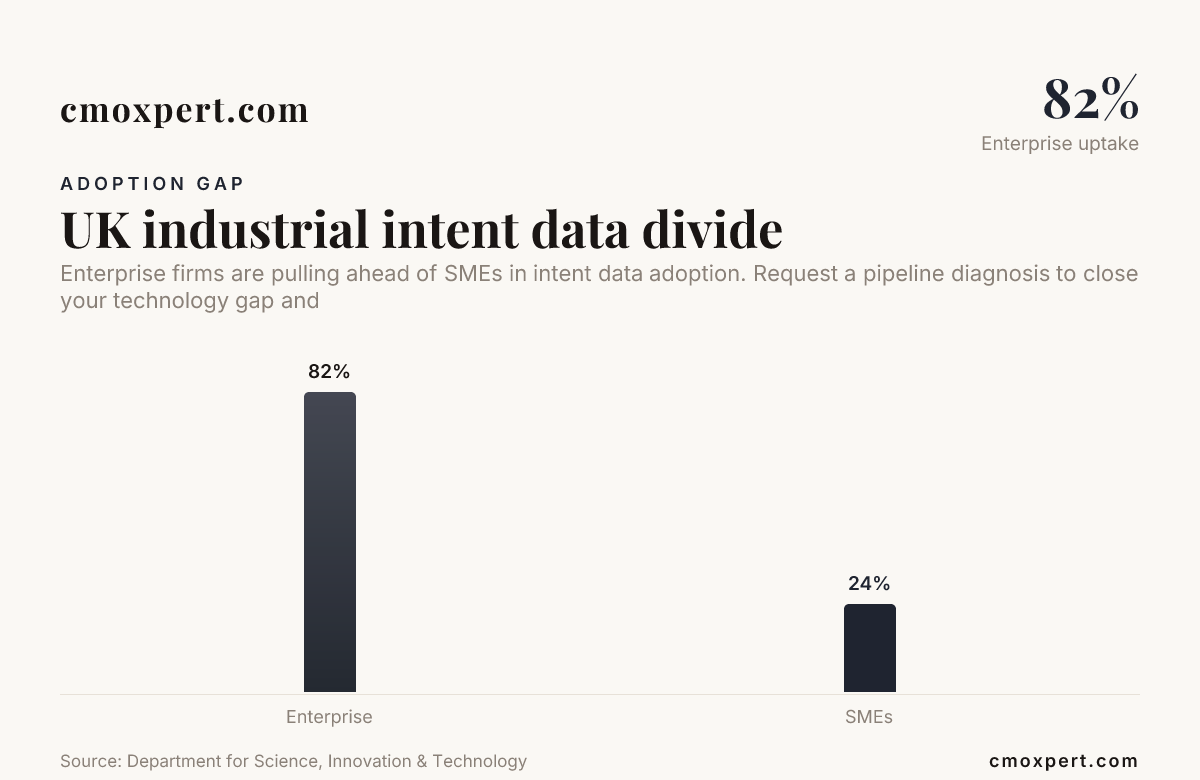
Enterprise firms are pulling ahead of SMEs in intent data adoption. Request a pipeline diagnosis to close your technology gap and stay competitive.

The Fully-Loaded Commercial Cost of Getting This Wrong
The manufacturing sector’s median marketing budget sits at 5.7% of revenue in 2026, a clear pivot toward account-based programmes and AI tooling. Spending that budget on the wrong intent stack does not just waste money, it hands the account to a competitor who reached the specification stage first.
ABM-led programmes generate 2.6x more pipeline per marketing dollar than broad-reach demand generation, with win rates up 41% over traditional methods. Those numbers only hold if the underlying data feeding the ABM programme is accurate and mapped to the right committee members.
No vanity metrics. No impressions. No reach reports. If your provider cannot show Pipeline Velocity and Cost Per Acquisition, not Cost Per Click, you are paying for noise.
We are not the right firm for every manufacturer. We are the right firm for the ones who are serious about winning, and serious enough to request a pipeline diagnosis before spending another pound on unverified intent software.
Conclusion
Comparing intent data providers for UK industrial sectors in 2026 is not about picking the platform with the most impressive logo wall. It is about matching signal depth, committee mapping, and implementation cost to the reality of your sales cycle.
Enterprise platforms like 6sense work for firms with the resource to run them. Multi-source stacks close coverage gaps for everyone else. Neither works without pipeline architecture behind it.
If this does not describe your business, we are not the right firm for you. If it does, request a pipeline diagnosis before you spend another quarter guessing at intent.
Frequently Asked Questions
What are intent data providers for UK industrial sectors, and how do they work in 2026?
They are platforms and data stacks that track digital research behaviour, such as content consumption and technographic signals, to show which accounts are actively researching your product category. In 2026, the strongest providers combine multiple sources rather than relying on one.
Is 6sense worth it for a UK industrial manufacturer?
Only if you have the RevOps resource to manage a three to six month implementation and can justify a starting cost around $35,000 a year. For most mid-sized manufacturers, a fractional pipeline architecture retainer delivers better fully-loaded commercial cost outcomes.
How much does intent data software cost for industrial companies?
Enterprise platforms start from roughly $35,000 annually, while multi-source aggregators and fractional retainers can start from around £3,000 a month depending on scope. The right comparison always factors in implementation time and internal resource, not just the licence fee.
Do I need more than one intent data provider?
Yes, in most cases. Multi-source strategies improve signal coverage by 20% to 30% compared to single-provider setups, which matters when buying committees average 11.2 stakeholders on larger deals.
What is the difference between intent data and traditional lead generation?
Traditional lead generation waits for a form fill or a trade show conversation. Intent data identifies research activity before that contact happens, giving you visibility at the moment of intent rather than the moment of enquiry.
How long does it take to see results from an intent data platform?
Enterprise platforms typically need three to six months before producing usable signal. Fractional pipeline architecture retainers integrated with your existing CRM can start generating qualified pipeline data within weeks.
Should industrial manufacturers request a pipeline diagnosis before buying intent software?
Yes. A genuine pipeline diagnosis identifies where your sales cycle actually stalls, specification stage, commercial negotiation, or procurement approval, before you spend budget on a platform that may not address the real bottleneck.